
Lincoln County Projected vs Actual Release
A projected, presumptive, conditional, minimum, or maximum date describes a calculation or legal milestone. An actual release date records an event that occurred. The difference is crucial in Lincoln County because a court-authorized outcome can lead to community release, a MODOC transfer, another jail, or federal or immigration custody. Disappearance from the county’s current JailTracker does not identify which event happened.
For someone awaiting trial at the Lincoln County Detention Center, use the case docket, bond status, jail information line, and any release sheet. Do not calculate a date from the charge. For a sentenced person, first identify whether the sentence is being served in the county jail or a Missouri prison because state-prison statutes should not be applied to an unsourced local jail calculation.
Missouri Release Date Labels for Lincoln
Missouri sources use several terms that sound similar but answer different questions. Preserving the label prevents a sentence boundary from being misreported as the expected prison exit.
| Official term | What it means |
|---|---|
| Sentence Maximum Release Date | An exact MODOC Sunshine-file label for a calculated sentence bound. |
| Sentence-I Minimum Release Date | Another exact Sunshine-file label for the sentence’s calculated minimum bound. |
| Presumptive release date | A Parole Board date contingent on conduct, programs, and an acceptable release plan. |
| Conditional release date | The beginning of the statutorily defined supervised portion for an eligible sentence. |
| Projected time credit release date | The term in 14 CSR 10-5.010 for a conditional-release date adjusted by potential administrative-parole time credit. |
| Actual release date | The completed custody event verified in an agency record. |
The live MODOC detail label “Projected Release Date” was not independently verified through the CAPTCHA during research. Use the sourced terms above rather than asserting that a generic field appears in the public interface.
The difference also affects requests. A person asking only for a “release date” may receive a minimum, maximum, or Board date that does not answer when custody actually ended. Identify the desired field, the source record, and whether the request concerns prison exit, conditional release, or final discharge from supervision.
Note: Preserve the exact date label and its source, since minimum, maximum, presumptive, conditional, and actual dates are not interchangeable.
Find a Lincoln County Projected Release Date
Begin with custody type, then follow the source that owns the time calculation. This avoids using a state-prison estimate for a county sentence or treating an active-supervision date as final discharge.
- Check whether the person is in the Lincoln County Detention Center, a MODOC institution, active community supervision, federal custody, or another facility.
- For a state case, search the MODOC Offender Web Search by full name or DOC ID and verify the match.
- Read each date with its exact label and note the displayed data-current time, assigned place, status, offense, and cause number.
- Ask the institutional caseworker for the current time computation when the public record does not expose a clear projected field.
- For a county-jail sentence, review the signed judgment in Case.net and ask the jail for its calculation and actual release record.
- If the person is finally discharged and absent from the active search, use the MODOC Sunshine file and request the final discharge certificate or order.
The Lincoln County release search guide helps identify the custody layer before a date is interpreted. MODOC Constituent Services can answer general policy and search questions at 573-526-2695 or constituentservices@doc.mo.gov when supplied with the full name, DOC ID, date of birth, and other stable identifiers.
Lincoln County Release Date Clues in MODOC
MODOC’s active offender search includes prison and community-supervision records, but expressly omits discharged offenders. Its nightly Sunshine Law File supplies the historical route and includes people who are or have been supervised. The layout provides DOC ID, assigned place, cause number, county, offense, sentence details, minimum and maximum date fields, and a Completed Flag.
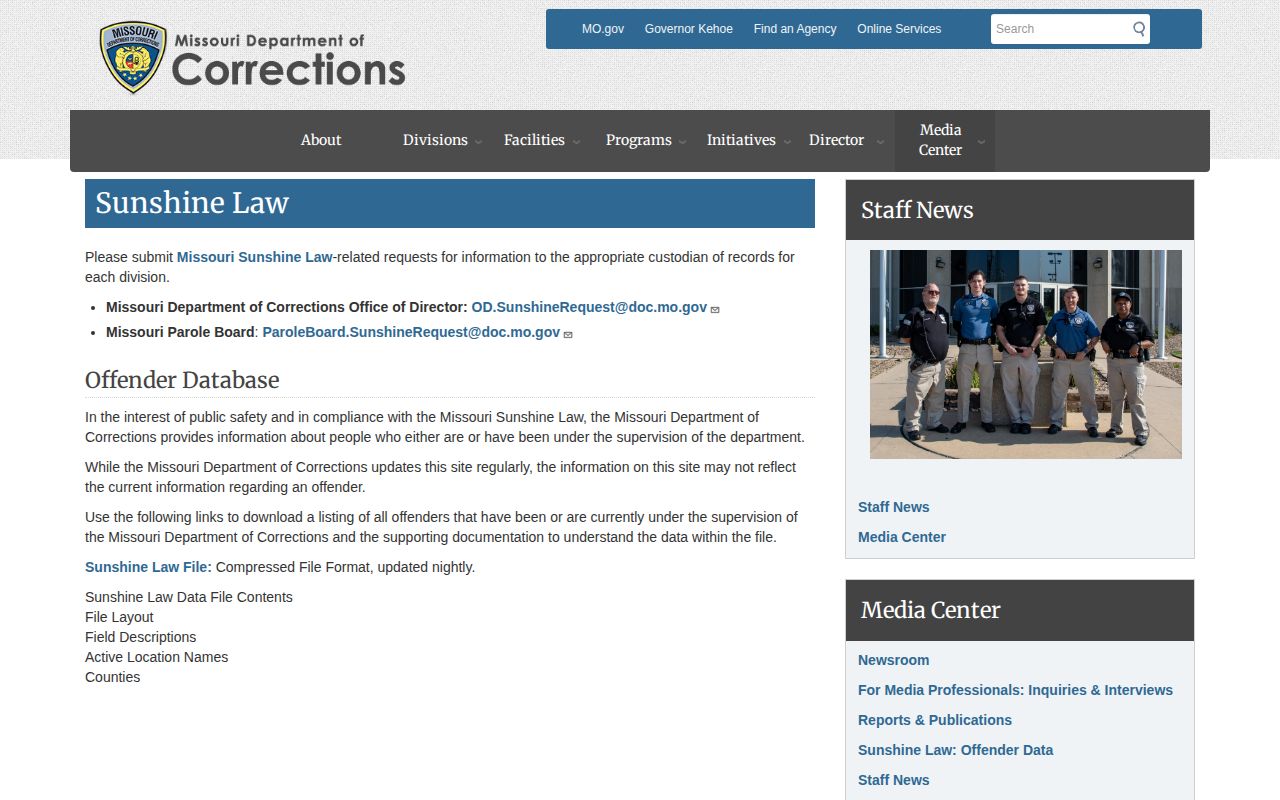
The historical file can preserve a Lincoln County state-sentence trail after the active search drops the person, but it does not label a certified actual discharge time.
A minimum date, maximum date, and Completed Flag “N” describe an incomplete sentence record and calculated bounds. They do not identify a certain future exit. Some records also use special placeholder values, including a nonordinary value for life sentences. Ask the agency for the current computation instead of converting a placeholder into a calendar date.
Missouri Computes Lincoln County Prison Release
RSMo §558.011 divides many ordinary term-of-years felony sentences between imprisonment and conditional release. For terms of nine years or less, the conditional-release portion is generally one-third. For terms longer than nine through fifteen years, it is three years. For terms longer than fifteen years, it is five years. Exclusions, offense-specific minimums, and other rules can change that structure, and the Board may extend conditional release after institutional rule or program violations through the statutory process.
A nine-year eligible ordinary term illustrates the framework: the general statute describes a three-year conditional-release portion and the rest as prison. That does not permit a reliable date calculation for a named person. Dangerous-felony status, prior commitments, credited custody, sentence corrections, concurrent or consecutive treatment, institutional conduct, required programs, and Board action all matter.
RSMo §558.041 permits eligible prison time credit on the superintendent’s recommendation under DOC policy, but it does not guarantee credit. Credits may be forfeited. Under 14 CSR 10-5.010, possible administrative-parole credits include one calendar month per sentence year for Class A or B and two months per year for Class C or D, subject to broad eligibility limits and institutional and Board review.
Note: A projected time credit release date remains conditional on eligibility and process; it is not a promise of a Lincoln County release.
Missouri’s 85 Percent Rule in Lincoln County
The often-repeated 85 percent rule is not universal. Under RSMo §558.019, a dangerous-felony offender must serve 85 percent of the sentence or meet the statute’s age-seventy and forty-percent alternative, when applicable. The dangerous-felony definition is found in §556.061. The same minimum-prison-term statute contains 40, 50, and 80 percent rules for specified non-dangerous offenses based on prior commitments.
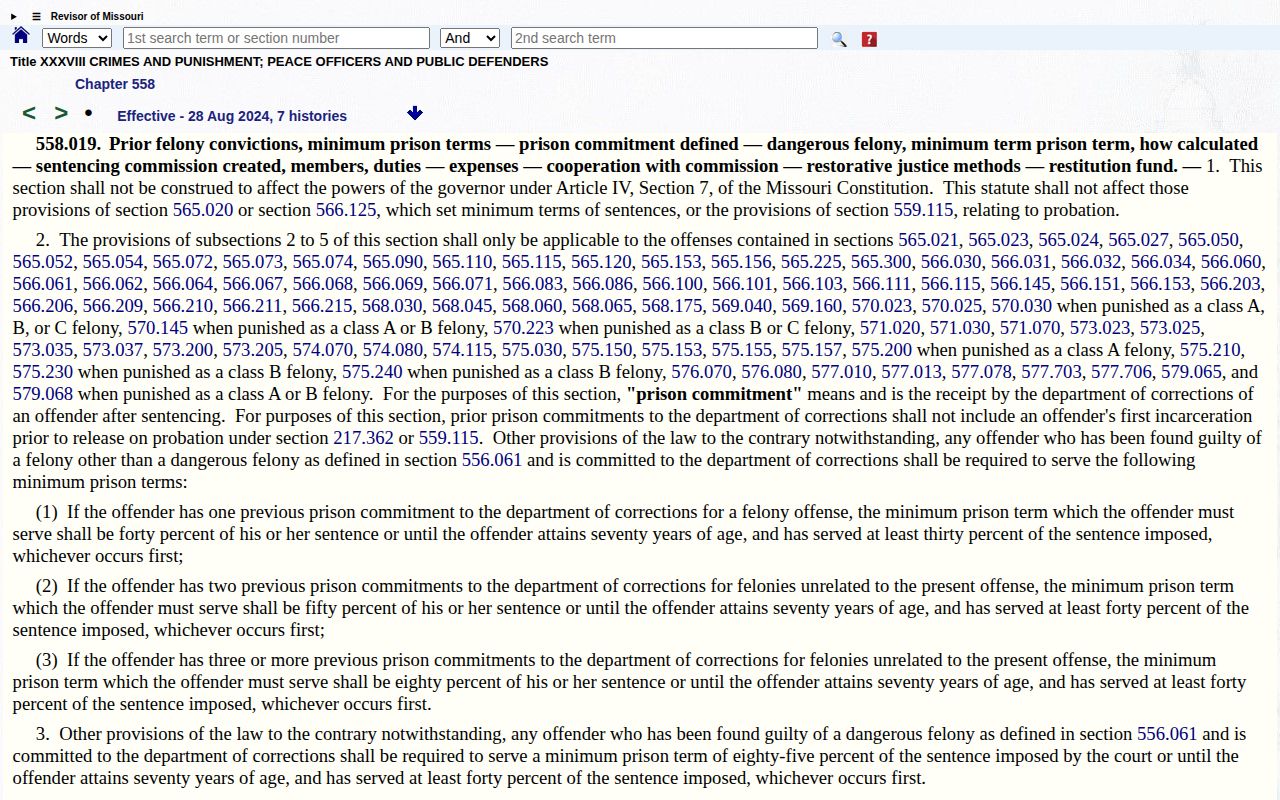
The statute image reinforces why the offense and sentence record must be checked before applying a percentage to a Lincoln County case.
Life sentences and long aggregate terms also have statutory calculation rules. No single percentage should be selected from a charge name, booking report, or online summary. Use the signed judgment, correct statutory classification, credited custody, and MODOC computation.
Lincoln County Supervision Credits and Prison Release
Earned Compliance Credits under RSMo §217.703 belong to community supervision. Eligible people may receive thirty days of credit for each full compliant calendar month, subject to exclusions, minimum time, violations, absconder periods, restitution, and other statutory limits. These credits can move final discharge from probation, parole, or conditional release.
They do not retroactively establish when a person left prison or the Lincoln County jail. Keep three milestones apart: physical release from custody, the start of parole or conditional release, and final discharge from supervision. An active MODOC search may find a person between the first and third milestone because community supervision remains active.
What Changes Lincoln County Projected Release Dates?
A date can move for reasons within the sentence calculation or because a different legal authority prevents release. Some events affect prison exit, while others affect only the end of supervision.
| Factor | Possible effect |
|---|---|
| Corrected judgment | Changes the sentence, offense treatment, or calculation base. |
| Concurrent or consecutive terms | Changes how multiple sentences combine. |
| Jail or prison credit | Recalculation can move a minimum, maximum, or expected date. |
| Institutional violation | Can affect conditional release or time-credit eligibility. |
| Required program | Noncompletion may affect a contingent Board date. |
| Parole Board action | A presumptive date can be set, changed, denied, or rescinded. |
| New sentence or detainer | May keep the person in custody or transfer them to another agency. |
A conviction or sentence can also be vacated, and a parole or conditional-release violation can return someone to custody. When a date moves, compare the latest judgment, the MODOC data-current time, the institutional computation, and any Board decision. Do not overwrite an older value; retain it with its original “as of” date so the change can be explained.
Note: Keep each earlier value with its original “as of” date so a later Lincoln County release-date change remains traceable.
Can Warrants Stop Lincoln County Release?
Yes. The Lincoln County Detention Center handbook says staff conduct a routine active-warrant check immediately before release. This local step means a calculated date, completed bond process, or court release order may not end in community release when another valid legal basis for custody appears.
No local county-jail good-time formula or weekend-release statute or policy was verified. Use the sentencing judgment and the jail’s own calculation rather than importing Missouri prison-credit rules. The Lincoln County Jail Division page supplies the current-custody link and the contact for immediate status. If the expected date arrives and the person remains listed, ask about a new order, detainer, transfer, recalculated credit, or the pre-release warrant check.
Confirm a Lincoln County Actual Release Date
For the detention center, use the county’s Sunshine request instructions to ask the Lincoln County Sheriff Records Division for the booking and release sheet, actual release time and type, destination or receiving agency, detainer disposition, and incarceration letter. The letter is offered free at release or transfer, so its destination context matters. Records Division is at 65 Business Park Drive in Troy, 636-462-6501, and is open Monday through Thursday from 8 a.m. to 4:30 p.m., except holidays.
For a state prisoner, ask the institutional caseworker for a pending calculation and MODOC for the official release or discharge record after the event. A MOVANS alert can report a custody change, but it is not a certified release document. The Lincoln County VINELink inmate check explains Missouri’s current MOVANS registration and its agency-specific limits.
If the jail, court, and MODOC appear to disagree, check whether each record describes a different event. The Lincoln County courts page identifies the local Justice Center for a signed order. A court commitment can precede physical transfer, a county release line can mark handoff to state custody, and a MODOC field date can mark supervision rather than freedom from all legal restraint. The best final account states the event, agency, date label, and source together.
Retain the source’s data-current or print time as well. A later agency update may explain why two otherwise accurate Lincoln County records show different dates.
Note: An actual release date belongs to the agency event record, not to a forecast reconstructed from sentence length alone.